Do you know the effect that you prefer to try out their favorite data pretreatments in combination and often try the same wavelength selections based spectra of the visualized?
You try as six to ten combinations until one of them selects his favorite calibration model, to then continue to optimize. Since then suddenly fall to outliers, because it goes in depth, so is familiar with the data, we know now the spectra of numbers of outliers and is familiar with the extreme values.
Now, the focus is on the major components (principal components, Latent Variables, factors) and makes sure not to over-fit and under-fit not to. The whole takes a few hours and finally one is content with the model found.
So what would happen if you all in the beginning tried variants found outliers removed and re-evaluated and compared? The results would be better than that of the previous model choice? One does not try out? Because it is cumbersome and takes hours again?
We have developed a software which simplifies this so that also the number of model variations can be increased as desired. The variants generation is automated with an intelligent control system, as well as the optimization and comparing the models and finally the final selection of the best calibration model.
Our software includes all the usual known data pretreatment methods (data pre-processing) and can combine them useful. Since many Preteatments are directly dependent on the wavelength selection, such as the normalization the determined within a wavelength range of the scaling factors to normalize the spectra so that pretreatments with the wavelength ranges may be combined. So a variety of settings sensible model comes together that are all calculated and optimized.
For the automatic selection of the relevant wavelength ranges, different methods are used, which are based on the spectral intensities. Thus, for example, regions with total absorption is not used, and often interfering water bands removed or retained.
Over all the calculated model variations as a summary outlier analysis can be made. Are there any new outliers (hidden outlier) discovered, all previous models can be automatically recalculated, optimized and compared without these outliers.
From this great number of calculated models with the statistical quality reviews (prediction performance) the optimum calibration can now be selected. For this purpose, not simply sorting by the prediction error (prediction error, SEP RMSEP) or the coefficient of determination (coefficient of determination r2), but by several statistical and test values are used jointly toward the final assessment of optimal calibration.
Thus we have created a platform that allows the highly automated work what a man can never do with a commercial software.
We therefore offer the largest number of matched to your application problem modeling calculations and choose the best calibration for you!
This means that our results are faster, more accurate, robust and objective basis (person independent) and quite easy for you to apply.
You have the full control of the models supplied by us, because we provide a clearly structured and detailed blueprint of the complete calibration, with all settings and parameters, with all necessary statistical characteristics and graphics.
Using this blueprint, you can adjust the quantitative calibration model itself in the software you use, understand and compare. You have everything under control form model creation, model validation and model refinement.
Your privacy is very important to us. The NIR data that you briefly provide us for the custom calibration development will remain of course your property. Your NIR data will be deleted after the job with us.
Start Calibrate
Interested, then do not hesitate to contact us.
Kennen Sie den Effekt, dass Sie bevorzugt ihre Lieblings-Datenvorbehandlungen in Kombination durchprobieren und oft die gleichen Wellenlängen-Selektionen anhand der visualisierten Spektren ausprobieren?
Man probiert z.B. sechs bis zehn Kombinationen aus, bis man davon sein favorisiertes Kalibrationsmodell auswählt, um es dann weiter zu optimieren. Da fallen dann plötzlich Ausreisser (Outlier) auf, weil man in die Tiefe geht, also mit den Daten vertraut ist, man kennt mittlerweile die Spektren-Nummern der Ausreisser und ist mit den Extremwerten vertraut.
Jetzt fokussiert man sich auf die Hauptkomponenten (Principal Components, Latent Variables, Faktoren) und achtet darauf nicht zu über-fitten und nicht zu unter-fitten. Das ganze dauert ein paar Stunden und schliesslich begnügt man sich mit dem gefundenen Modell.
Was wäre nun, wenn man in all den zu Beginn ausprobierten Varianten, die gefundenen Ausreisser entfernt und nochmals berechnet und vergleicht? Wären die Ergebnisse besser als die von der bisherigen Modell Wahl? Man probiert es nicht aus? Weil es mühsam ist und wieder Stunden dauert?
Wir haben eine Software entwickelt die dies so vereinfacht, dass auch die Anzahl der Modell Variationen beliebig erhöht werden kann. Die Varianten Erzeugung läuft automatisiert mit einem intelligenten Regelsystem, so auch die Optimierung und das Vergleichen der Modelle und schliesslich die finale Auswahl des Besten Kalibrations Modell.
Unsere Software beinhaltet alle üblichen bekannten Datenvorbehandlungs Methoden (Preteatments) und kann diese sinnvoll kombinieren. Da viele Preteatments direkt abhängig sind von der Wellenlängen Selektion, so z.B. die Normalisierungen die innerhalb eines Wellenlängen-Bereiches die Skalierungsfaktoren ermittelt, um die Spektren damit zu normieren, werden die Pretreatments mit dem Wellenlängen-Bereichen kombiniert. So kommt eine Vielzahl von sinnvollen Modell Einstellungen zusammen die alle berechnet und optimiert werden.
Für die automatische Auswahl der relevanten Wellenlängen Bereiche kommen verschiedene Methoden zum Einsatz, die sich an den Spektren Intensitäten orientieren. So werden z.B. Bereiche mit Totalabsorption nicht verwendet, oftmals störende Wasserbanden entfernt oder beibehalten.
Über all die berechneten Modell Variationen können so zusammenfassende Outlier Analysen gemacht werden. Werden durch die gefahrenen Versuche neue Outlier (Hidden Outlier) entdeckt, können alle bisherigen Modelle automatisch ohne diese Ausreisser nachberechnet, optimiert und verglichen werden.
Aus dieser Vielzahl berechneter Modelle mit deren Statistischen Güte Bewertungen (Prediction Performance) kann nun die optimale Kalibration ausgewählt werden. Dazu wird nicht einfach nach dem Vorhersage Fehler (Prediction Error, SEP, RMSEP) oder nach dem Bestimmtheitsmaß (Coefficient of Determination r2) sortiert, sondern mehrere Statistik- und Testwerte gemeinsam zur umfänglichen Beurteilung der optimalen Kalibration herangezogen.
Somit haben wir eine Plattform geschaffen, die es ermöglicht hochgradig automatisiert das zu tun, was ein Mensch niemals mit einer handelsüblichen Software tun kann.
Wir bieten damit die grösste Anzahl auf Ihr Applikations-Problem angepasste Modellierungs-Berechnungen und wählen die beste Kalibration für Sie aus!
Das heisst, unsere Ergebnisse sind schneller, genauer, robuster und objektiv ausgewählt (Personen unabhängig) und für Sie ganz einfach anzuwenden.
Die Kontrolle über die von uns gelieferten Modelle haben Sie vollumfänglich, denn wir liefern einen klar strukturierten und detaillierten Bauplan der kompletten Kalibration, mit allen Einstellungen und Parametern, mit allen notwendigen Statistischen Kenngrössen und Grafiken.
Anhand dieses Bauplans können Sie das quantitative Kalibrations Modell selbst in der von Ihnen verwendeten Software nachstellen, nachvollziehen und vergleichen. Sie haben so alles im Griff, für die Modell-Validierung und die Modellpflege.
Der Datenschutz ist uns sehr wichtig. Die NIR Daten, die Sie uns für die Kalibrations-Erstellung kurzzeitig zu Verfügung stellen bleiben selbstverständlich Ihr Eigentum. Ihre NIR Daten werden nach Abschluss des Auftrags bei uns gelöscht.
Start Calibrate
Interessiert, dann zögern Sie nicht uns zu kontaktieren.
Do you know the effect that you prefer to try out their favorite data pretreatments in combination and often try the same wavelength selections based spectra of the visualized?
You try as six to ten combinations until one of them selects his favorite calibration model, to then continue to optimize. Since then suddenly fall to outliers, because it goes in depth, so is familiar with the data, we know now the spectra of numbers of outliers and is familiar with the extreme values.
Now, the focus is on the major components (principal components, Latent Variables, factors) and makes sure not to over-fit and under-fit not to. The whole takes a few hours and finally one is content with the model found.
So what would happen if you all in the beginning tried variants found outliers removed and re-evaluated and compared? The results would be better than that of the previous model choice? One does not try out? Because it is cumbersome and takes hours again?
We have developed a software which simplifies this so that also the number of model variations can be increased as desired. The variants generation is automated with an intelligent control system, as well as the optimization and comparing the models and finally the final selection of the best calibration model.
Our software includes all the usual known data pretreatment methods (data pre-processing) and can combine them useful. Since many Preteatments are directly dependent on the wavelength selection, such as the normalization the determined within a wavelength range of the scaling factors to normalize the spectra so that pretreatments with the wavelength ranges may be combined. So a variety of settings sensible model comes together that are all calculated and optimized.
For the automatic selection of the relevant wavelength ranges, different methods are used, which are based on the spectral intensities. Thus, for example, regions with total absorption is not used, and often interfering water bands removed or retained.
Over all the calculated model variations as a summary outlier analysis can be made. Are there any new outliers (hidden outlier) discovered, all previous models can be automatically recalculated, optimized and compared without these outliers.
From this great number of calculated models with the statistical quality reviews (prediction performance) the optimum calibration can now be selected. For this purpose, not simply sorting by the prediction error (prediction error, SEP RMSEP) or the coefficient of determination (coefficient of determination r2), but by several statistical and test values are used jointly toward the final assessment of optimal calibration.
Thus we have created a platform that allows the highly automated work what a man can never do with a commercial software.
We therefore offer the largest number of matched to your application problem modeling calculations and choose the best calibration for you!
This means that our results are faster, more accurate, robust and objective basis (person independent) and quite easy for you to apply.
You have the full control of the models supplied by us, because we provide a clearly structured and detailed blueprint of the complete calibration, with all settings and parameters, with all necessary statistical characteristics and graphics.
Using this blueprint, you can adjust the quantitative calibration model itself in the software you use, understand and compare. You have everything under control form model creation, model validation and model refinement.
Your privacy is very important to us. The NIR data that you briefly provide us for the custom calibration development will remain of course your property. Your NIR data will be deleted after the job with us.
Start Calibrate
Interested, then do not hesitate to contact us.
NIRS Calibration Model Equation – Optimal Predictive Model SelectionNIRS Calibration Model Equation – Optimal Predictive Model SelectionNIRS Calibration Model Equation – Optimal Predictive Model Selection
To give you an insight what we do to find the optimal model, imagine a NIR data set, where a NIR specialist works hard for 4 hours in his chemometric software to try what he can with his chemometric-, NIR spectroscopic- and his product-knowledge to get a good model. During the 4 hours he finds 3 final candidate models for his application. With the RMSEP of 0.49 , 0.51 and 0.6. Now he has to choose one or to test all his three models on new measured NIR spectra.
That is common practice. But is this good practice?
And nobody asks, how long, how hard have you tried, how many trial have you done, if this really the best model that is possible from the data?
And imagine the cost of the data collection including the lab analytics!
And behind this costs, have you really tried hard enough to get the best out of your data? Was the calibration done quick and dirty on a Friday afternoon? Yes, time is limited and manually clicking around and wait in such kind of software is not really fun, so what are the consequences?
Now I come to the most important core point ever, if you own expensive NIR spectrometer system, or even many of them, and your company has collected a lot of NIR spectra and expensive Lab-reference data over years, do you spend just a few hours to develop and build that model, that will define the whole system's measurement performance for the future? And ask yourself again (and your boss will ask you later), have you really tried hard enough, to get the best out of your data? really?
What else is possible? What does your competition do?
There is no measure (yet) what can be reached with a specific NIR data set.
And this is very interesting, because there are different beliefs if a secondary method like NIR or Raman can be more precise and accurate, as the primary method.
What we do different is, that our highly specialized software is capable of creating large amounts of useful calibrations to investigate this limits – what is possible. It's done by permutation and combination of spectra-selection, wave-selection, pre-processing sequences and PC selections. If you are common with this, then you know that the possibilities are huge.
For a pre-screening, we create e.g. 42'000 useful calibrations for the mentioned data set. With useful we mean that the model is usable, e.g. R² is higher than 0.8, which shows a good correlation between the spectra and the constituent and it is well fitted (neither over-fitted nor under-fitted) because the PC selection for the calibration-set is estimated by the validation-set and the predictive performance of the test-set is used for model comparisons.
Here the sorted RMSEP values of the Test Set is shown for 42'000 calibrations.
You can immediately see that the manually found performance of 0.49 is just in the starting phase of our optimization. Interesting is the steep fall from 1.0 to 0.5 where manually optimization found it's solutions. A range where ca. 2500 different useful calibrations exist. The following less steep fall from 0.5 to 0.2 contains a lot more useful models and between 0.2 to 0.08 the obvious high accurate models are around 2500 different ones. So the golden needle is not in the first 2500 models, it must be somewhere in the last 2500 models in the haystack.
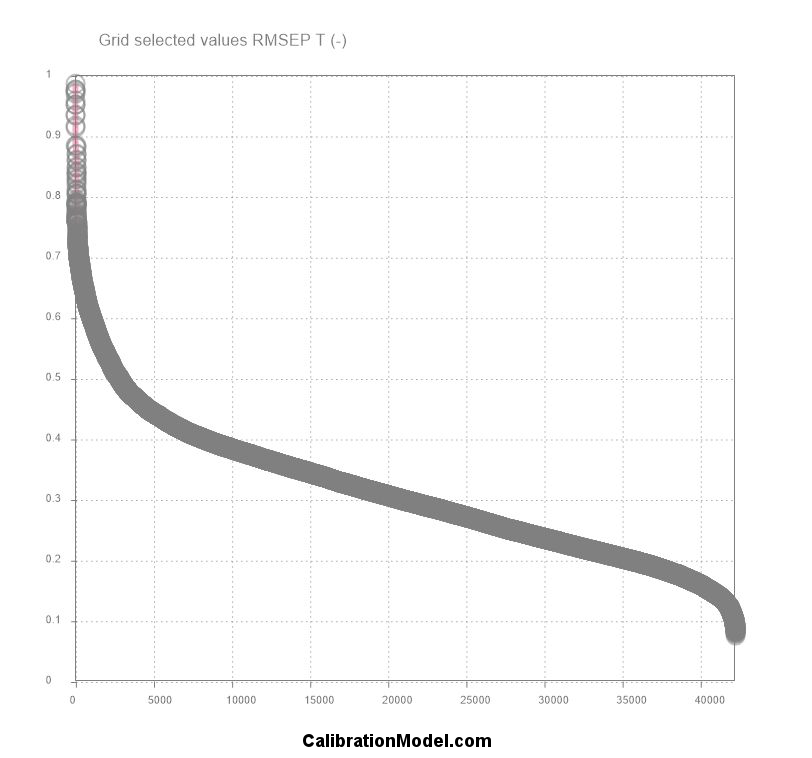
That allows us to pick the best calibration out of 42'000 models, depending on multiple statistical evaluation criteria, that is not just the R² or RPD, SEC, SEP or RMSEP, (or Akaike Information Criterion (AIC), Bayesian Information Criterion (BIC), Multivariate AIC (MAIC) etc.) we do the model selection based on multiple statistical parameters.
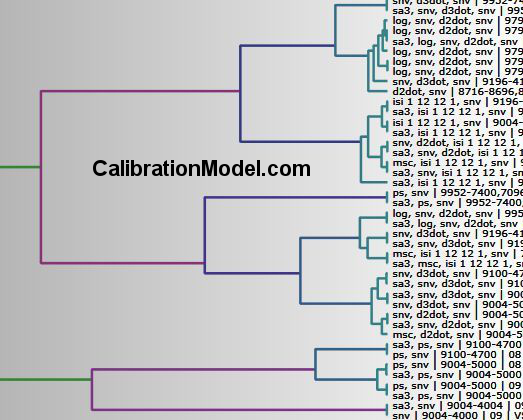
To compare the calibration models by similarity it is best viewed with dendrogram plots like this (zoomed in), where the settings are shown versus the models overall performance similarity. In the settings you can see a lot of different permutations of pre-processings combined with different wave-selections.
To give you an insight what we do to find the optimal model, imagine a NIR data set, where a NIR specialist works hard for 4 hours in his chemometric software to try what he can with his chemometric-, NIR spectroscopic- and his product-knowledge to get a good model. During the 4 hours he finds 3 final candidate models for his application. With the RMSEP of 0.49 , 0.51 and 0.6. Now he has to choose one or to test all his three models on new measured NIR spectra.
That is common practice. But is this good practice?
And nobody asks, how long, how hard have you tried, how many trial have you done, if this really the best model that is possible from the data?
And imagine the cost of the data collection including the lab analytics!
And behind this costs, have you really tried hard enough to get the best out of your data? Was the calibration done quick and dirty on a Friday afternoon? Yes, time is limited and manually clicking around and wait in such kind of software is not really fun, so what are the consequences?
Now I come to the most important core point ever, if you own expensive NIR spectrometer system, or even many of them, and your company has collected a lot of NIR spectra and expensive Lab-reference data over years, do you spend just a few hours to develop and build that model, that will define the whole system's measurement performance for the future? And ask yourself again (and your boss will ask you later), have you really tried hard enough, to get the best out of your data? really?
What else is possible? What does your competition do?
There is no measure (yet) what can be reached with a specific NIR data set.
And this is very interesting, because there are different beliefs if a secondary method like NIR or Raman can be more precise and accurate, as the primary method.
What we do different is, that our highly specialized software is capable of creating large amounts of useful calibrations to investigate this limits – what is possible. It's done by permutation and combination of spectra-selection, wave-selection, pre-processing sequences and PC selections. If you are common with this, then you know that the possibilities are huge.
For a pre-screening, we create e.g. 42'000 useful calibrations for the mentioned data set. With useful we mean that the model is usable, e.g. R² is higher than 0.8, which shows a good correlation between the spectra and the constituent and it is well fitted (neither over-fitted nor under-fitted) because the PC selection for the calibration-set is estimated by the validation-set and the predictive performance of the test-set is used for model comparisons.
Here the sorted RMSEP values of the Test Set is shown for 42'000 calibrations.
You can immediately see that the manually found performance of 0.49 is just in the starting phase of our optimization. Interesting is the steep fall from 1.0 to 0.5 where manually optimization found it's solutions. A range where ca. 2500 different useful calibrations exist. The following less steep fall from 0.5 to 0.2 contains a lot more useful models and between 0.2 to 0.08 the obvious high accurate models are around 2500 different ones. So the golden needle is not in the first 2500 models, it must be somewhere in the last 2500 models in the haystack.
That allows us to pick the best calibration out of 42'000 models, depending on multiple statistical evaluation criteria, that is not just the R² or RPD, SEC, SEP or RMSEP, (or Akaike Information Criterion (AIC), Bayesian Information Criterion (BIC), Multivariate AIC (MAIC) etc.) we do the model selection based on multiple statistical parameters.
To compare the calibration models by similarity it is best viewed with dendrogram plots like this (zoomed in), where the settings are shown versus the models overall performance similarity. In the settings you can see a lot of different permutations of pre-processings combined with different wave-selections.
To give you an insight what we do to find the optimal model, imagine a NIR data set, where a NIR specialist works hard for 4 hours in his chemometric software to try what he can with his chemometric-, NIR spectroscopic- and his product-knowledge to get a good model. During the 4 hours he finds 3 final candidate models for his application. With the RMSEP of 0.49 , 0.51 and 0.6. Now he has to choose one or to test all his three models on new measured NIR spectra.
That is common practice. But is this good practice?
And nobody asks, how long, how hard have you tried, how many trial have you done, if this really the best model that is possible from the data?
And imagine the cost of the data collection including the lab analytics!
And behind this costs, have you really tried hard enough to get the best out of your data? Was the calibration done quick and dirty on a Friday afternoon? Yes, time is limited and manually clicking around and wait in such kind of software is not really fun, so what are the consequences?
Now I come to the most important core point ever, if you own expensive NIR spectrometer system, or even many of them, and your company has collected a lot of NIR spectra and expensive Lab-reference data over years, do you spend just a few hours to develop and build that model, that will define the whole system's measurement performance for the future? And ask yourself again (and your boss will ask you later), have you really tried hard enough, to get the best out of your data? really?
What else is possible? What does your competition do?
There is no measure (yet) what can be reached with a specific NIR data set.
And this is very interesting, because there are different beliefs if a secondary method like NIR or Raman can be more precise and accurate, as the primary method.
What we do different is, that our highly specialized software is capable of creating large amounts of useful calibrations to investigate this limits – what is possible. It's done by permutation and combination of spectra-selection, wave-selection, pre-processing sequences and PC selections. If you are common with this, then you know that the possibilities are huge.
For a pre-screening, we create e.g. 42'000 useful calibrations for the mentioned data set. With useful we mean that the model is usable, e.g. R² is higher than 0.8, which shows a good correlation between the spectra and the constituent and it is well fitted (neither over-fitted nor under-fitted) because the PC selection for the calibration-set is estimated by the validation-set and the predictive performance of the test-set is used for model comparisons.
Here the sorted RMSEP values of the Test Set is shown for 42'000 calibrations.
You can immediately see that the manually found performance of 0.49 is just in the starting phase of our optimization. Interesting is the steep fall from 1.0 to 0.5 where manually optimization found it's solutions. A range where ca. 2500 different useful calibrations exist. The following less steep fall from 0.5 to 0.2 contains a lot more useful models and between 0.2 to 0.08 the obvious high accurate models are around 2500 different ones. So the golden needle is not in the first 2500 models, it must be somewhere in the last 2500 models in the haystack.
That allows us to pick the best calibration out of 42'000 models, depending on multiple statistical evaluation criteria, that is not just the R² or RPD, SEC, SEP or RMSEP, (or Akaike Information Criterion (AIC), Bayesian Information Criterion (BIC), Multivariate AIC (MAIC) etc.) we do the model selection based on multiple statistical parameters.
To compare the calibration models by similarity it is best viewed with dendrogram plots like this (zoomed in), where the settings are shown versus the models overall performance similarity. In the settings you can see a lot of different permutations of pre-processings combined with different wave-selections.
That is common practice. But is this good practice?
And nobody asks, how long, how hard have you tried, how many trial have you done, if this really the best model that is possible from the data?
And imagine the cost of the data collection including the lab analytics!
And behind this costs, have you really tried hard enough to get the best out of your data? Was the calibration done quick and dirty on a Friday afternoon? Yes, time is limited and manually clicking around and wait in such kind of software is not really fun, so what are the consequences?
Now I come to the most important core point ever, if you own expensive NIR spectrometer system, or even many of them, and your company has collected a lot of NIR spectra and expensive Lab-reference data over years, do you spend just a few hours to develop and build that model, that will define the whole system's measurement performance for the future? And ask yourself again (and your boss will ask you later), have you really tried hard enough, to get the best out of your data? really?
What else is possible? What does your competition do?
There is no measure (yet) what can be reached with a specific NIR data set.
And this is very interesting, because there are different beliefs if a secondary method like NIR or Raman can be more precise and accurate, as the primary method.
What we do different is, that our highly specialized software is capable of creating large amounts of useful calibrations to investigate this limits – what is possible. It's done by permutation and combination of spectra-selection, wave-selection, pre-processing sequences and PC selections. If you are common with this, then you know that the possibilities are huge.
For a pre-screening, we create e.g. 42'000 useful calibrations for the mentioned data set. With useful we mean that the model is usable, e.g. R² is higher than 0.8, which shows a good correlation between the spectra and the constituent and it is well fitted (neither over-fitted nor under-fitted) because the PC selection for the calibration-set is estimated by the validation-set and the predictive performance of the test-set is used for model comparisons.
Here the sorted RMSEP values of the Test Set is shown for 42'000 calibrations.
You can immediately see that the manually found performance of 0.49 is just in the starting phase of our optimization. Interesting is the steep fall from 1.0 to 0.5 where manually optimization found it's solutions. A range where ca. 2500 different useful calibrations exist. The following less steep fall from 0.5 to 0.2 contains a lot more useful models and between 0.2 to 0.08 the obvious high accurate models are around 2500 different ones. So the golden needle is not in the first 2500 models, it must be somewhere in the last 2500 models in the haystack.
That allows us to pick the best calibration out of 42'000 models, depending on multiple statistical evaluation criteria, that is not just the R² or RPD, SEC, SEP or RMSEP, (or Akaike Information Criterion (AIC), Bayesian Information Criterion (BIC), Multivariate AIC (MAIC) etc.) we do the model selection based on multiple statistical parameters.
To compare the calibration models by similarity it is best viewed with dendrogram plots like this (zoomed in), where the settings are shown versus the models overall performance similarity. In the settings you can see a lot of different permutations of pre-processings combined with different wave-selections.
To give you an insight what we do to find the optimal model, imagine a NIR data set, where a NIR specialist works hard for 4 hours in his chemometric software to try what he can with his chemometric-, NIR spectroscopic- and his product-knowledge to get a good model. During the 4 hours he finds 3 final candidate models for his application. With the RMSEP of 0.49 , 0.51 and 0.6. Now he has to choose one or to test all his three models on new measured NIR spectra.
That is common practice. But is this good practice?
And nobody asks, how long, how hard have you tried, how many trial have you done, if this really the best model that is possible from the data?
And imagine the cost of the data collection including the lab analytics!
And behind this costs, have you really tried hard enough to get the best out of your data? Was the calibration done quick and dirty on a Friday afternoon? Yes, time is limited and manually clicking around and wait in such kind of software is not really fun, so what are the consequences?
Now I come to the most important core point ever, if you own expensive NIR spectrometer system, or even many of them, and your company has collected a lot of NIR spectra and expensive Lab-reference data over years, do you spend just a few hours to develop and build that model, that will define the whole system's measurement performance for the future? And ask yourself again (and your boss will ask you later), have you really tried hard enough, to get the best out of your data? really?
What else is possible? What does your competition do?
There is no measure (yet) what can be reached with a specific NIR data set.
And this is very interesting, because there are different beliefs if a secondary method like NIR or Raman can be more precise and accurate, as the primary method.
What we do different is, that our highly specialized software is capable of creating large amounts of useful calibrations to investigate this limits – what is possible. It's done by permutation and combination of spectra-selection, wave-selection, pre-processing sequences and PC selections. If you are common with this, then you know that the possibilities are huge.
For a pre-screening, we create e.g. 42'000 useful calibrations for the mentioned data set. With useful we mean that the model is usable, e.g. R² is higher than 0.8, which shows a good correlation between the spectra and the constituent and it is well fitted (neither over-fitted nor under-fitted) because the PC selection for the calibration-set is estimated by the validation-set and the predictive performance of the test-set is used for model comparisons.
Here the sorted RMSEP values of the Test Set is shown for 42'000 calibrations.
You can immediately see that the manually found performance of 0.49 is just in the starting phase of our optimization. Interesting is the steep fall from 1.0 to 0.5 where manually optimization found it's solutions. A range where ca. 2500 different useful calibrations exist. The following less steep fall from 0.5 to 0.2 contains a lot more useful models and between 0.2 to 0.08 the obvious high accurate models are around 2500 different ones. So the golden needle is not in the first 2500 models, it must be somewhere in the last 2500 models in the haystack.
That allows us to pick the best calibration out of 42'000 models, depending on multiple statistical evaluation criteria, that is not just the R² or RPD, SEC, SEP or RMSEP, (or Akaike Information Criterion (AIC), Bayesian Information Criterion (BIC), Multivariate AIC (MAIC) etc.) we do the model selection based on multiple statistical parameters.
To compare the calibration models by similarity it is best viewed with dendrogram plots like this (zoomed in), where the settings are shown versus the models overall performance similarity. In the settings you can see a lot of different permutations of pre-processings combined with different wave-selections.
To give you an insight what we do to find the optimal model, imagine a NIR data set, where a NIR specialist works hard for 4 hours in his chemometric software to try what he can with his chemometric-, NIR spectroscopic- and his product-knowledge to get a good model. During the 4 hours he finds 3 final candidate models for his application. With the RMSEP of 0.49 , 0.51 and 0.6. Now he has to choose one or to test all his three models on new measured NIR spectra.
That is common practice. But is this good practice?
And nobody asks, how long, how hard have you tried, how many trial have you done, if this really the best model that is possible from the data?
And imagine the cost of the data collection including the lab analytics!
And behind this costs, have you really tried hard enough to get the best out of your data? Was the calibration done quick and dirty on a Friday afternoon? Yes, time is limited and manually clicking around and wait in such kind of software is not really fun, so what are the consequences?
Now I come to the most important core point ever, if you own expensive NIR spectrometer system, or even many of them, and your company has collected a lot of NIR spectra and expensive Lab-reference data over years, do you spend just a few hours to develop and build that model, that will define the whole system's measurement performance for the future? And ask yourself again (and your boss will ask you later), have you really tried hard enough, to get the best out of your data? really?
What else is possible? What does your competition do?
There is no measure (yet) what can be reached with a specific NIR data set.
And this is very interesting, because there are different beliefs if a secondary method like NIR or Raman can be more precise and accurate, as the primary method.
What we do different is, that our highly specialized software is capable of creating large amounts of useful calibrations to investigate this limits – what is possible. It's done by permutation and combination of spectra-selection, wave-selection, pre-processing sequences and PC selections. If you are common with this, then you know that the possibilities are huge.
For a pre-screening, we create e.g. 42'000 useful calibrations for the mentioned data set. With useful we mean that the model is usable, e.g. R² is higher than 0.8, which shows a good correlation between the spectra and the constituent and it is well fitted (neither over-fitted nor under-fitted) because the PC selection for the calibration-set is estimated by the validation-set and the predictive performance of the test-set is used for model comparisons.
Here the sorted RMSEP values of the Test Set is shown for 42'000 calibrations.
You can immediately see that the manually found performance of 0.49 is just in the starting phase of our optimization. Interesting is the steep fall from 1.0 to 0.5 where manually optimization found it's solutions. A range where ca. 2500 different useful calibrations exist. The following less steep fall from 0.5 to 0.2 contains a lot more useful models and between 0.2 to 0.08 the obvious high accurate models are around 2500 different ones. So the golden needle is not in the first 2500 models, it must be somewhere in the last 2500 models in the haystack.
That allows us to pick the best calibration out of 42'000 models, depending on multiple statistical evaluation criteria, that is not just the R² or RPD, SEC, SEP or RMSEP, (or Akaike Information Criterion (AIC), Bayesian Information Criterion (BIC), Multivariate AIC (MAIC) etc.) we do the model selection based on multiple statistical parameters.
To compare the calibration models by similarity it is best viewed with dendrogram plots like this (zoomed in), where the settings are shown versus the models overall performance similarity. In the settings you can see a lot of different permutations of pre-processings combined with different wave-selections.
White Paper : A novel knowledge-based Chemometrics Software for NIR SpectroscopyWhite Paper : Eine neuartige wissensbasierte Chemometrie Software für die NIR-Spektroskopie
Download our free White Paper about a novel knowledge-based Chemometrics Software for NIR Spectroscopy.Downloade unser gratis White Paper über eine neuartige wissensbasierte Chemometrie Software für die NIR-Spektroskopie.
NIR Calibration Modeling (Part 2)NIR Kalibrationsentwicklung (Teil 2)NIR calibrazione Modeling (parte 2)
( to part 1 )
All the below categories are implemented by using multiple different algorithms and formulas which leads to many different calibrations.
Steps in modeling
The problem of choosing the optimal number of factors to find the optimum between underfitting and overfitting is solved by having multiple methods and protocols implemented leading to multiple calibrations.
The evaluation and the selection of the best calibration is based on many individual statistical values including the most popular RMSEP, SEP, Bias, SEC, R2 and PCs etc.
Results and Reporting
A detailed calibration report is provided detailing the best available calibration containing all calibration parameter settings and statistics of prediction performance of the calibration set, the validation set and the test set. A visual expression of the calibration is provided with the most importance plots.
Our service works with any quantitative NIR spectra data set in the standard JCAMP-DX format and uses mainly PLS and PCR to be compatible with other chemometric calibration software.
( zu Teil 1 )
Alle folgenden Kategorien werden durch die Verwendung mehrerer verschiedener Algorithmen und Formeln umgesetzt, was zu vielen unterschiedlichen Kalibrierungen führt.
Arbeitsschritte bei der Modell Erstellung
Das Problem der Wahl der optimalen Anzahl von Faktoren, um das Optimum zwischen Unterfittung und Überfittung zu finden, wird gelöst durch mehrere implementierte Methoden und Protokollen, was zu mehreren Kalibrierungen führt.
Die Auswertung und die Auswahl der besten Kalibrierung basiert auf vielen einzelnen statistischen Werten, einschließlich der beliebtesten RMSEP, SEP, Bias, SEC, R2 und PCs usw.
Ergebnisse und Berichte
Eine detailliertes Kalibrierprotokoll wird bereitgestellt, das die beste verfügbare Kalibrierung detailliert mit allen Kalibrierparameter Einstellungen und Statistiken der Vorhersage Leistung des Kalibrier-Sets, des Validierungs-Sets und des Test-Sets beinhaltet. Eine visuelle Betrachtung der Kalibrierung wird mit den wichtigsten Grafiken zur Verfügung gestellt.
Unser Service funktioniert mit jedem quantitative NIR-Spektren Daten Satz im Standardformat JCAMP-DX-Format und verwendet hauptsächlich PLS und PCR um kompatibel zu sein mit anderen chemometrischen Kalibrierungssoftwaren.
( to part 1 )
All the below categories are implemented by using multiple different algorithms and formulas which leads to many different calibrations.
Steps in modeling
The problem of choosing the optimal number of factors to find the optimum between underfitting and overfitting is solved by having multiple methods and protocols implemented leading to multiple calibrations.
The evaluation and the selection of the best calibration is based on many individual statistical values including the most popular RMSEP, SEP, Bias, SEC, R2 and PCs etc.
Results and Reporting
A detailed calibration report is provided detailing the best available calibration containing all calibration parameter settings and statistics of prediction performance of the calibration set, the validation set and the test set. A visual expression of the calibration is provided with the most importance plots.
Our service works with any quantitative NIR spectra data set in the standard JCAMP-DX format and uses mainly PLS and PCR to be compatible with other chemometric calibration software.
All the below categories are implemented by using multiple different algorithms and formulas which leads to many different calibrations.
Steps in modeling
- Data Cleaning - (bad data, missing values, duplicate elimination, spectral quality / intensity / noise, input value typing errors, …)
- Initial Calibration set up - selection of calibration, validation and test samples
- Wavelengths selection
- Data preprocessing, pretreatments
- Method calculation
- Choosing the number of Principal Components / Latent Variables
- Validation of calibration model / Statistics of performance - (accuracy, precision, linearity, repeatability, range, distribution, robustness / stability, sensitivity, simplicity, etc.)
- Outlier examination and removal
The problem of choosing the optimal number of factors to find the optimum between underfitting and overfitting is solved by having multiple methods and protocols implemented leading to multiple calibrations.
The evaluation and the selection of the best calibration is based on many individual statistical values including the most popular RMSEP, SEP, Bias, SEC, R2 and PCs etc.
Results and Reporting
A detailed calibration report is provided detailing the best available calibration containing all calibration parameter settings and statistics of prediction performance of the calibration set, the validation set and the test set. A visual expression of the calibration is provided with the most importance plots.
Our service works with any quantitative NIR spectra data set in the standard JCAMP-DX format and uses mainly PLS and PCR to be compatible with other chemometric calibration software.
( zu Teil 1 )
Alle folgenden Kategorien werden durch die Verwendung mehrerer verschiedener Algorithmen und Formeln umgesetzt, was zu vielen unterschiedlichen Kalibrierungen führt.
Arbeitsschritte bei der Modell Erstellung
- Daten Bereinigung - (schlechte Daten, fehlende Werte, Duplikateliminierung, spektrale Qualität / Intensität / Rauschen, Eingabewert Tippfehler, ...)
- Initial Kalibrierung einrichten - Auswahl der Kalibrierungs-, Validierungs- und Test-Sets
- Wellenlängen Auswahl
- Datenvorverarbeitung, Datenvorbehandlungen
- Method Berechnung
- Die Wahl der Anzahl der Hauptkomponenten / Latente Variablen / Faktoren
- Validierung des Kalibrierungs Modell / Performance Statistiken - (Genauigkeit, Präzision, Linearität, Wiederholbarkeit, Reichweite, Verteilung, Robustheit / Stabilität, Empfindlichkeit, Einfachheit, etc.)
- Ausreißer Untersuchung und Beseitigung
Das Problem der Wahl der optimalen Anzahl von Faktoren, um das Optimum zwischen Unterfittung und Überfittung zu finden, wird gelöst durch mehrere implementierte Methoden und Protokollen, was zu mehreren Kalibrierungen führt.
Die Auswertung und die Auswahl der besten Kalibrierung basiert auf vielen einzelnen statistischen Werten, einschließlich der beliebtesten RMSEP, SEP, Bias, SEC, R2 und PCs usw.
Ergebnisse und Berichte
Eine detailliertes Kalibrierprotokoll wird bereitgestellt, das die beste verfügbare Kalibrierung detailliert mit allen Kalibrierparameter Einstellungen und Statistiken der Vorhersage Leistung des Kalibrier-Sets, des Validierungs-Sets und des Test-Sets beinhaltet. Eine visuelle Betrachtung der Kalibrierung wird mit den wichtigsten Grafiken zur Verfügung gestellt.
Unser Service funktioniert mit jedem quantitative NIR-Spektren Daten Satz im Standardformat JCAMP-DX-Format und verwendet hauptsächlich PLS und PCR um kompatibel zu sein mit anderen chemometrischen Kalibrierungssoftwaren.
( to part 1 )
All the below categories are implemented by using multiple different algorithms and formulas which leads to many different calibrations.
Steps in modeling
- Data Cleaning - (bad data, missing values, duplicate elimination, spectral quality / intensity / noise, input value typing errors, …)
- Initial Calibration set up - selection of calibration, validation and test samples
- Wavelengths selection
- Data preprocessing, pretreatments
- Method calculation
- Choosing the number of Principal Components / Latent Variables
- Validation of calibration model / Statistics of performance - (accuracy, precision, linearity, repeatability, range, distribution, robustness / stability, sensitivity, simplicity, etc.)
- Outlier examination and removal
The problem of choosing the optimal number of factors to find the optimum between underfitting and overfitting is solved by having multiple methods and protocols implemented leading to multiple calibrations.
The evaluation and the selection of the best calibration is based on many individual statistical values including the most popular RMSEP, SEP, Bias, SEC, R2 and PCs etc.
Results and Reporting
A detailed calibration report is provided detailing the best available calibration containing all calibration parameter settings and statistics of prediction performance of the calibration set, the validation set and the test set. A visual expression of the calibration is provided with the most importance plots.
Our service works with any quantitative NIR spectra data set in the standard JCAMP-DX format and uses mainly PLS and PCR to be compatible with other chemometric calibration software.
Summary of the NIR Chemometric survey pollsSummary of the NIR Chemometric survey polls
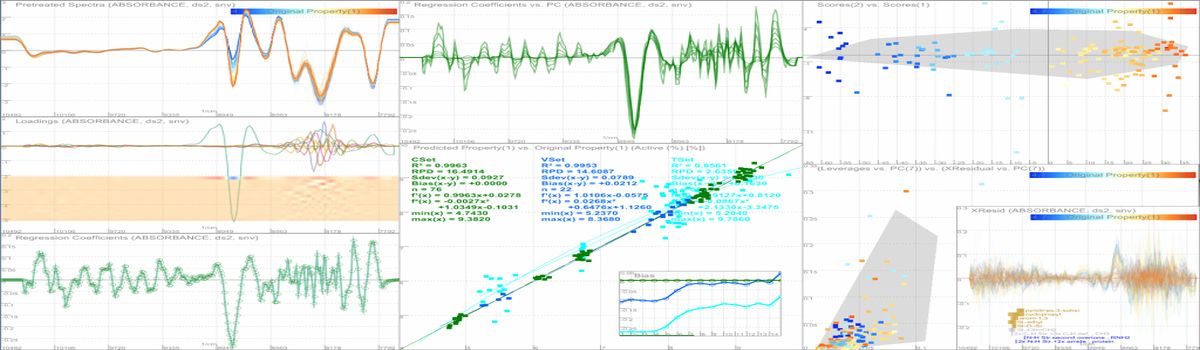
Summary of the NIR Chemometric  survey polls (as of end of Sept. 2013)
The interesting finding is that most of the answers fit the following pattern. The most companies that use NIR have one NIR Instrument and only one employee that is able to develop NIR calibrations. For that the most common off-the-shelf chemometrics program is used and spent 2 hours or over a month and therefore gets no calibration training about the complex topics like Chemometrics and NIR Spectroscopy or only once (introduction). The calibration maintenance ranges from never to 3 times a year. Interestingly, there was no one who uses portable NIR instruments. We continue our surveys, for the discovery of new trends. Conclusion Seeing this picture, we think that there is huge potential to improve the calibrations. Advanced knowledge can help individuals to build the calibrations with best practices and improve their models accuracy and reliability. Once the decision and investment in NIR technology is done, you should get the best out of your data, because this extra NIR performance can be given by calibration optimization. We offer this as an easy to use and independent service.
Summary of the NIR Chemometric survey polls (as of end of Sept. 2013)
The interesting finding is that most of the answers fit the following pattern. The most companies that use NIR have one NIR Instrument and only one employee that is able to develop NIR calibrations. For that the most common off-the-shelf chemometrics program is used and spent 2 hours or over a month and therefore gets no calibration training about the complex topics like Chemometrics and NIR Spectroscopy or only once (introduction). The calibration maintenance ranges from never to 3 times a year. Interestingly, there was no one who uses portable NIR instruments. We continue our surveys, for the discovery of new trends. Conclusion Seeing this picture, we think that there is huge potential to improve the calibrations. Advanced knowledge can help individuals to build the calibrations with best practices and improve their models accuracy and reliability. Once the decision and investment in NIR technology is done, you should get the best out of your data, because this extra NIR performance can be given by calibration optimization. We offer this as an easy to use and independent service.
Customized NIR CalibrationsAngepasste NIR KalibrationenTarature NIR personalizzate
Increase Your Profit with optimized NIR Accuracy
We help you to find the optimal settings for higher NIR accuracy and reliability.
You can build your own custom NIR calibration model with this valuable settings.
We offer a quantitative NIR Calibration development and optimization service.
New: free NIR-Predictor Software
White Paper about the details, what's behind.
Start Calibrate
 Improve NIR Measurement Accuracy

- going closer to your product specification limits and maximize profitability
- optimizing your models yield to process optimization and optimizing productivity
- compete against other NIR vendors in a feasibility study (NIR salesman)
 Easy to use

- compatible with any NIR vendor
- no installation, no learning
- quantitative NIR Calibration Development as a Service
 Safety
- help users avoid common pitfalls of method development
- before you validate and approve your solution for use in production process:
- check if a better calibration can be found,
- compare your calibration with other experts solutions.
 Speed
Speed

- no cumbersome trial-and-error modeling steps
- calculation time is spent on our high performance infrastructure
- fast results, developed calibrations within days
 Fix price
- fix costs, depends only on data size (not hourly rate for service)
- huge saving in method development costs
- easy to plan
Steigern Sie Ihren Gewinn mit optimierter NIR Genauigkeit
Wir helfen Ihnen, die optimalen Einstellungen für eine höhere NIR Genauigkeit und Zuverlässigkeit zu finden.
Sie können Ihre eigenen NIR-Kalibrierungs Modelle mit diesen optimierten Einstellungen erzeugen.
Wir bieten einen quantitative NIR-Kalibrierung und Optimierungs Service.
Neu: free NIR-Predictor Software
White Paper (English) über die Details, was dahinter steckt.
Start Calibrate
NIR Messgenauigkeit Verbessern
- näher an Ihre Produkt Spezifikationsgrenzwerte gehen und Rentabilität maximieren
- Optimierung Ihrer Modelle ergeben eine Prozessoptimierung und Optimierung der Produktivität
- Wettbewerb gegen andere NIR-Anbieter in einer Machbarkeitsstudie
Einfach anzuwenden
- kompatibel mit jedem NIR Anbieter
- keine Installation, kein Lernen
- quantitative NIR Calibration Development as a Service
Sicherheit
- hilft häufige Fehler bei der Methodenentwicklung zu vermeiden
- bevor Sie Ihre Lösung validieren und freigeben für den Einsatz in der Produktion:
- überprüfen Sie ob eine bessere Kalibrierung gefunden werden kann
- vergleichen Sie Ihre Kalibrierung mit Lösungen anderer Experten
Geschwindigkeit
- keine umständliche Versuch-und-Irrtum Modellierungs Schritte
- Rechenzeit auf unseren Hochleistungs-Infrastruktur auslagern
- schnelle Ergebnisse, Kalibrierungen innerhalb weniger Tage entwickelt
Festpreisangebote
- Fixkosten, hängt nur von Datengröße ab (nicht Stundensatz für Service)
- enorme Einsparung bei den Methodenentwicklungs Kosten
- einfach zu planen
Increase Your Profit with optimized NIR Accuracy
We help you to find the optimal settings for higher NIR accuracy and reliability.
You can build your own custom NIR calibration model with this valuable settings.
We offer a quantitative NIR Calibration development and optimization service.
New: free NIR-Predictor Software
White Paper about the details, what's behind.
Start Calibrate
Improve NIR Measurement Accuracy
- going closer to your product specification limits and maximize profitability
- optimizing your models yield to process optimization and optimizing productivity
- compete against other NIR vendors in a feasibility study (NIR salesman)
Easy to use
- compatible with any NIR vendor
- no installation, no learning
- quantitative NIR Calibration Development as a Service
Safety
- help users avoid common pitfalls of method development
- before you validate and approve your solution for use in production process:
- check if a better calibration can be found,
- compare your calibration with other experts solutions.
Speed
- no cumbersome trial-and-error modeling steps
- calculation time is spent on our high performance infrastructure
- fast results, developed calibrations within days
Fix price
- fix costs, depends only on data size (not hourly rate for service)
- huge saving in method development costs
- easy to plan
NIR Calibration ModelingNIR Kalibrationsentwicklung
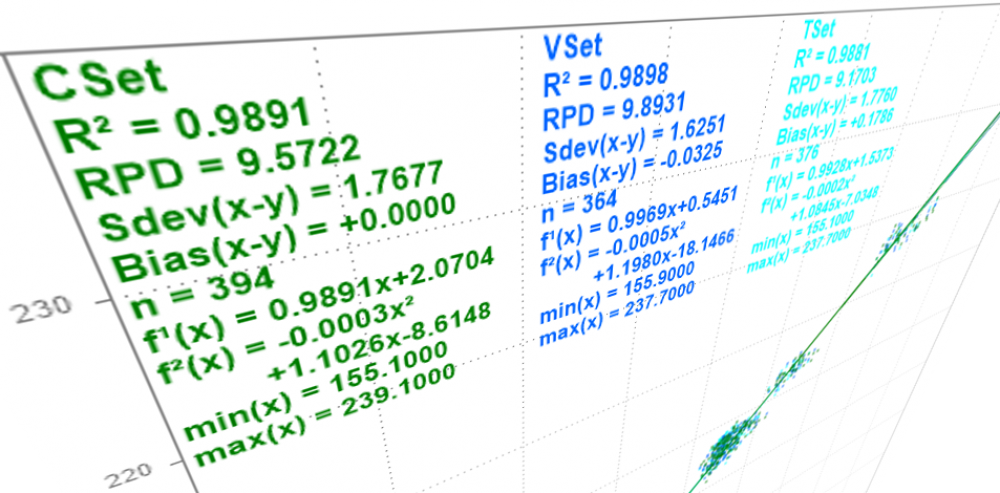
The majority of NIR calibrations are generated using a small number of different parameter settings and all too often are restricted to the time a user has available, their spectroscopic and chemometric knowledge and their ability (tedious use of the software) to choose and combine all the possible parameter settings required for good calibrations.
There are many published standards and guidelines (protocols) available for developing NIR calibrations from Standards Consortium such as ASTM, EMEA, ICH, IUPAC, ISO, USP, PASG etc. as well as many good recommendations and guidelines found in various textbooks and papers.
The difficulty with so many ‘Protocols’ for the NIR user is to have them all available and in their thought processes during calibration work and in addition to execute, check and challenge all calibrations generated manually. This is time consuming and sometimes boring repetitive work.
To simplify this for the person generating the NIR Calibrations, we have collected the good practices protocols and integrated them into our service that automates the calibration building and evaluation procedures.
to part 2
Die Mehrheit der NIR Kalibrierungen werden unter Verwendung einer kleinen Anzahl von verschiedenen Parametereinstellungen erzeugt und allzu oft eingeschränkt durch die zu Verfügung stehende Zeit die ein Benutzer hat, deren spektroskopisches und chemometrisches Fachwissen und die Fähigkeit (mühsames bedienen der Software) alle möglichen Parametereinstellungen zu wählen und zu kombinieren, die für gute Kalibrierungen erforderlich sind.
Es gibt viele veröffentlichte Normen und Richtlinien (Protokolle) für die Entwicklung von NIR-Kalibrierungen von Normierungsbehörden wie ASTM, EMEA, ICH, IUPAC, ISO, USP, PASG etc. sowie viele gute Empfehlungen und Richtlinien die in verschiedenen Lehrbüchern und Fachbeiträgen gefunden werden können.
Die Schwierigkeit mit so vielen 'Protokollen' für den NIR Benutzer besteht darin, dass sie alle verfügbar und in ihren Denkprozessen präsent sind während der Kalibrierungs Arbeit und zusätzlich beim Ausführen, Überprüfen und Bewerten aller manuell erzeugten Kalibrierungen. Dies ist zeitaufwendig und manchmal langweilig wiederholende Arbeit.
Um dies für die Person die NIR-Kalibrierung entwickeln zu vereinfachen, haben wir die guten Praktiken Protokolle gesammelt und sie in unseren Service integriert, der die Kalibrierungs Erstellung und das Evaluierungsverfahren automatisiert.
zu Teil 2
The majority of NIR calibrations are generated using a small number of different parameter settings and all too often are restricted to the time a user has available, their spectroscopic and chemometric knowledge and their ability (tedious use of the software) to choose and combine all the possible parameter settings required for good calibrations.
There are many published standards and guidelines (protocols) available for developing NIR calibrations from Standards Consortium such as ASTM, EMEA, ICH, IUPAC, ISO, USP, PASG etc. as well as many good recommendations and guidelines found in various textbooks and papers.
The difficulty with so many ‘Protocols’ for the NIR user is to have them all available and in their thought processes during calibration work and in addition to execute, check and challenge all calibrations generated manually. This is time consuming and sometimes boring repetitive work.
To simplify this for the person generating the NIR Calibrations, we have collected the good practices protocols and integrated them into our service that automates the calibration building and evaluation procedures.
to part 2
There are many published standards and guidelines (protocols) available for developing NIR calibrations from Standards Consortium such as ASTM, EMEA, ICH, IUPAC, ISO, USP, PASG etc. as well as many good recommendations and guidelines found in various textbooks and papers.
The difficulty with so many ‘Protocols’ for the NIR user is to have them all available and in their thought processes during calibration work and in addition to execute, check and challenge all calibrations generated manually. This is time consuming and sometimes boring repetitive work.
To simplify this for the person generating the NIR Calibrations, we have collected the good practices protocols and integrated them into our service that automates the calibration building and evaluation procedures.
to part 2
Die Mehrheit der NIR Kalibrierungen werden unter Verwendung einer kleinen Anzahl von verschiedenen Parametereinstellungen erzeugt und allzu oft eingeschränkt durch die zu Verfügung stehende Zeit die ein Benutzer hat, deren spektroskopisches und chemometrisches Fachwissen und die Fähigkeit (mühsames bedienen der Software) alle möglichen Parametereinstellungen zu wählen und zu kombinieren, die für gute Kalibrierungen erforderlich sind.
Es gibt viele veröffentlichte Normen und Richtlinien (Protokolle) für die Entwicklung von NIR-Kalibrierungen von Normierungsbehörden wie ASTM, EMEA, ICH, IUPAC, ISO, USP, PASG etc. sowie viele gute Empfehlungen und Richtlinien die in verschiedenen Lehrbüchern und Fachbeiträgen gefunden werden können.
Die Schwierigkeit mit so vielen 'Protokollen' für den NIR Benutzer besteht darin, dass sie alle verfügbar und in ihren Denkprozessen präsent sind während der Kalibrierungs Arbeit und zusätzlich beim Ausführen, Überprüfen und Bewerten aller manuell erzeugten Kalibrierungen. Dies ist zeitaufwendig und manchmal langweilig wiederholende Arbeit.
Um dies für die Person die NIR-Kalibrierung entwickeln zu vereinfachen, haben wir die guten Praktiken Protokolle gesammelt und sie in unseren Service integriert, der die Kalibrierungs Erstellung und das Evaluierungsverfahren automatisiert.
zu Teil 2
The majority of NIR calibrations are generated using a small number of different parameter settings and all too often are restricted to the time a user has available, their spectroscopic and chemometric knowledge and their ability (tedious use of the software) to choose and combine all the possible parameter settings required for good calibrations.
There are many published standards and guidelines (protocols) available for developing NIR calibrations from Standards Consortium such as ASTM, EMEA, ICH, IUPAC, ISO, USP, PASG etc. as well as many good recommendations and guidelines found in various textbooks and papers.
The difficulty with so many ‘Protocols’ for the NIR user is to have them all available and in their thought processes during calibration work and in addition to execute, check and challenge all calibrations generated manually. This is time consuming and sometimes boring repetitive work.
To simplify this for the person generating the NIR Calibrations, we have collected the good practices protocols and integrated them into our service that automates the calibration building and evaluation procedures.
to part 2
NIR Spectroscopy and Chemometric surveys, polls and assessmentsNIR Spektroskopie und Chemometrie Umfragen, Erhebungen und WertungenSpettroscopia NIR e chemiometria sondaggi, indagini e valutazioni
1. Calibration Developers
How many persons in your company are able to develop a NIR Calibration?
2. Calibration Development
How much time do you spend to develop a calibration model?
3. Chemometric Software / Spectroscopy Software
Which Chemometric Software are you using for NIR?
4. NIR Spectrometer Brand
Which NIR Spectrometer Brand do you use?
Please vote and see the assessments below.
Part 2, Part 3
| [yop_poll id="5"] | [yop_poll id="4"] |
| [yop_poll id="2"] | [yop_poll id="3"] |
Part 2, Part 3
1. Calibration Developers
Wie viele Personen in Ihrem Unternehmen sind in der Lage, eine NIR-Kalibrierung zu entwickeln?
2. Calibration Development
Wie viel Zeit benötigen Sie um ein Kalibrierungs Modell zu entwickeln?
3. Chemometrie Software / Spectroskopie Software
Welche Chemometrische Software verwenden Sie für NIR?
4. NIR Spectrometer Brand
Welche NIR-Spektrometer Marke verwenden Sie?
Bitte stimmen Sie und sehen Sie die Einschätzungen unten.
| [yop_poll id="5"] | [yop_poll id="4"] |
| [yop_poll id="2"] | [yop_poll id="3"] |
1. Calibration Developers
How many persons in your company are able to develop a NIR Calibration?
2. Calibration Development
How much time do you spend to develop a calibration model?
3. Chemometric Software
Which Chemometric Software are you using for NIR?
4. NIR Spectrometer Brand
Which NIR Spectrometer Brand do you use?
Please vote and see the assessments below.
| [yop_poll id="5"] | [yop_poll id="4"] |
| [yop_poll id="2"] | [yop_poll id="3"] |
NIR Chemometric SoftwareNIR Chemometrie SoftwareNIR chemiometrico Software
We develop optimal and robust Near-Infrared (NIR) Spectroscopy Calibration Models for you.
So you can directly use it within the free NIR-Predictor Software!
(also available as SDK and OEM software)
Why You don't need a chemometric software to create a calibration.
Save cost, see Cost Comparision
This are lists of compatible chemometric software packages:
Chemometric software as a Service
Automatic NIR Chemometric Calibration Model Service with free NIR-Predictor software.
- NIR-Predictor - CalibrationModel.com - Bossart Analytics
- CalibrationModel.com - Bossart Analytics (http://www.CalibrationModel.com)

- Start Calibrate
Chemometric software bundled with NIR-Spectrometers *
- WinISI – FOSS (http://www.foss.dk),
- VISION – Metrohm NIRSystems (http://metrohm-nirsystems.com),
- Advertise your Company Here (http://calibrationmodel.com),

- OPUS – Bruker (http://www.bruker.com),
- NIRCal - BUCHI (http://www.buchi.com),
- PICS – Perten (http://www.perten.com),
- CalStar, UCal - Unity Scientific (http://www.unityscientific.com)
Standalone Chemometric software packages *
- UNSCRAMBLER – CAMO (http://www.camo.com),
- GRAMS/AI + PLSPlus/IQ – Thermo Scientific (https://www.thermo.com),
- SIMCA-P+ - UMETRICS (http://www.umetrics.com),
- PLS Toolbox, Solo - Eigenvector Inc. (http://www.eigenvector.com),
- Advertise your Company Here (http://calibrationmodel.com),
- Pirouette – Infometrix (http://www.infometrix.com),
- SL Calibration Workshop – SensoLogic (http://www.sensologic.com),
- AnalyzeIQ - AnalyzeIQ (http://www.AnalyzeIQ.com)
*) Disclaimer: We have no affiliation with any of these sites or their companies.
Wir entwickeln für Sie optimale und robuste Kalibriermodelle für die Nah-Infrarot (NIR)-Spektroskopie.
So können Sie diese direkt in der kostenlosen NIR-Prädiktor-Software verwenden! (auch als SDK und OEM-Software erhältlich)
Warum Sie keine chemometrische Software benötigen, um eine Kalibrierung zu erstellen.
Kosten sparen, siehe Kostenvergleich
Dies ist eine Auflistung von kompatiblen Chemometrie Software Paketen:
Chemometrie-Software als Service
Automatischer NIR-Chemometrie-Kalibrierungsmodell-Service mit kostenloser NIR-Predictor-Software.
- NIR-Predictor - CalibrationModel.com - Bossart Analytics
- CalibrationModel.com - Bossart Analytics (http://www.CalibrationModel.com)
- Start Calibrate
Chemometrie-Software gebündelt mit NIR-Spektrometer*
- WinISI – FOSS (http://www.foss.dk),
- VISION – Metrohm NIRSystems (http://metrohm-nirsystems.com),
- Advertise your Company Here (http://calibrationmodel.com),
- OPUS – Bruker (http://www.bruker.com),
- NIRCal - BUCHI (http://www.buchi.com),
- PICS – Perten (http://www.perten.com),
- CalStar, UCal - Unity Scientific (http://www.unityscientific.com)
Standalone Chemometric software packages *
- UNSCRAMBLER – CAMO (http://www.camo.com),
- GRAMS/AI + PLSPlus/IQ – Thermo Scientific (https://www.thermo.com),
- SIMCA-P+ - UMETRICS (http://www.umetrics.com),
- PLS Toolbox, Solo - Eigenvector Inc. (http://www.eigenvector.com),
- Advertise your Company Here (http://calibrationmodel.com),
- Pirouette – Infometrix (http://www.infometrix.com),
- SL Calibration Workshop – SensoLogic (http://www.sensologic.com),
- AnalyzeIQ - AnalyzeIQ (http://www.AnalyzeIQ.com)
*) Disclaimer: Wir haben keine Verbindung mit jeder dieser Sites oder deren Gesellschaften.
We develop optimal and robust Near-Infrared (NIR) Spectroscopy Calibration Models for you.
So you can directly use it within the free NIR-Predictor Software!
(also available as SDK and OEM software)
Why You don't need a chemometric software to create a calibration.
Save cost, see Cost Comparision
This are lists of compatible chemometric software packages:
Chemometric software as a Service
Servizio automatico di modello di calibrazione chemometrica NIR con il software gratuito NIR-Predictor.
- NIR-Predictor - CalibrationModel.com - Bossart Analytics
- CalibrationModel.com - Bossart Analytics (http://www.CalibrationModel.com)
- Start Calibrate
Chemometric software bundled with NIR-Spectrometers *
- WinISI – FOSS (http://www.foss.dk),
- VISION – Metrohm NIRSystems (http://metrohm-nirsystems.com),
- Advertise your Company Here (http://calibrationmodel.com),
- OPUS – Bruker (http://www.bruker.com),
- NIRCal - BUCHI (http://www.buchi.com),
- PICS – Perten (http://www.perten.com),
- CalStar, UCal - Unity Scientific (http://www.unityscientific.com)
Standalone Chemometric software packages *
- UNSCRAMBLER – CAMO (http://www.camo.com),
- GRAMS/AI + PLSPlus/IQ – Thermo Scientific (https://www.thermo.com),
- SIMCA-P+ - UMETRICS (http://www.umetrics.com),
- PLS Toolbox, Solo - Eigenvector Inc. (http://www.eigenvector.com),
- Advertise your Company Here (http://calibrationmodel.com),
- Pirouette – Infometrix (http://www.infometrix.com),
- SL Calibration Workshop – SensoLogic (http://www.sensologic.com),
- AnalyzeIQ - AnalyzeIQ (http://www.AnalyzeIQ.com)
*) Disclaimer: We have no affiliation with any of these sites or their companies.
BenefitNutzenBenefici
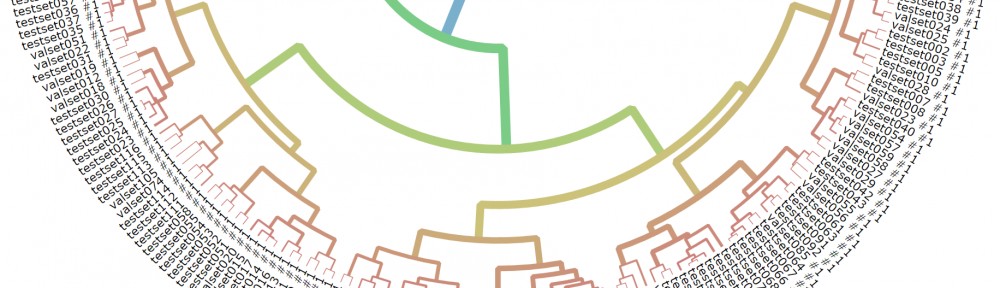
The NIR Calibration service offers the following benefit:
Saving money
- Improving the accuracy and reliability of already used NIR calibration models have high potential in various manufacturing processes as well as in quality assurance.
- increased accuracy of analysis => better control of the production process => optimum process flow => better quality => less waste => more throughput.
- quick and inexpensive to create professional NIR calibration models.
- relief of their own staff
- for data cleaning (increasing data quality) - missing data, outlier search, wrong data (conflicting information), outlier removal
- for the search for the optimal NIR model parameter settings (calibration set, wavelength selection, data pretreatments, factor selection)
- for the calculation of different variations of the model
- for the validation, evaluation and selection of the optimal model (error, SEP, RMSEP, RMSEC, RPD, fit, R2, bias, slope, ...)
- time-consuming calculation of huge calibration models
- no long trial and error and waiting in the used NIR software until the calibrations seems to work
- higher reliability due to accuracy and robustness of NIR calibration models
- the possibility of comparison with your own created or already existing or purchased NIR calibrations
- what performance increase of analytical accuracy is possible
- improvement of robustness with respect to change of the product matrix and possible instruments drift
- decades of experience in chemometrics for NIR spectroscopy
- based on theoretical and applied good practice and know-how
- application of various guidelines and rules
- application of vendor-independent NIR chemometric software
- outsourcing of NIR calibration method development and calibration equation maintenance
- improving the robustness of NIR prediction model
- avoid traps and pitfalls of the complicated chemometrics
- The service provides optimal calibration settings for your NIR data.
- You get full insight into the NIR calibration, as it is produced and detailed statistical values as a performance index assisted with graphics.
- Die Verbesserung der Genauigkeit und Zuverlässigkeit bereits eingesetzter/angewandter NIR Kalibrationsmodelle hat hohes Einsparpotenzial bei verschiedenen Produktions Prozessen wie auch in der Qualitätssicherung.
- Erhöhte Analysen Genauigkeit => den Produktionsprozess besser im Griff => optimaler Prozessablauf => bessere Qualität => weniger Ausschuss => mehr Durchsatz
- Schnell und günstig professionelle NIR Kalibrations Modelle erstellen.
- Entlasten von eigenem Personal
- beim Datenbereinigung (Steigerung der Datenqualität) - Fehlende Daten, Ausreisser Erkennung, fehlerhafte Daten (widersprüchliche Informationen), Ausreisser Elimination
- beim Suchen nach den optimalen Parameter Kombinationen für das Modell (calibration set, wavelength selection, data pretreatments, factor selection)
- beim zeitintensiven Berechnungen von diversen Variationen des Modells
- bei der Validation, Bewertung und Auswahl des optimalen Modells (error, SEP, RMSEP, RMSEC, RPD, fit, R2, bias, slope, ...)
- Nicht lange rumprobieren in der verwendeten NIR Software bis die Kalibration einigermassen funktioniert.
- höhere Zuverlässigkeit durch Genauigkeit und Robustheit der NIR Kalibrations Modelle
- Vergleichsmöglichkeit mit ihren eigenen erstellten oder schon vorhandenen oder gekauften NIR Kalibrationen
- was ist an Performance Steigerung der Analysen Genauigkeit möglich
- was ist an Robustheit bzgl. ändernder Produkt Matrix, Instrumenten Drift möglich
- Jahrzehnte lange Erfahrung in Chemometrics for NIR-Spectroscopy
- basierend auf theoretischer und angewandter Good Practice und Know How
- Anwendung verschiedenster Richtlinien und Regeln
- Anwendung von Hersteller unabhängiger NIR Chemometrie Software
- Auslagerung (Outsourcing) der NIR-Kalibrations Methoden Entwicklung und NIR Kalibrations Pflege
- Verbesserung der Robustheit von NIR-Kalibrationen
- Vermeidung von Fallstricken und Fallgruben der komplexen Chemometrie
- Der Service liefert die optimalen Kalibrations Einstellungen für ihre NIR Daten.
- Sie erhalten vollen Einblick in die NIR Kalibration, wie sie erzeugt wird und detaillierte statistische Werte als Performance Übersicht unterstützt mit Grafiken.
- Migliorando la precisione e l’affidabilità di modelli di calibrazione NIR pre-esistenti si possono aumentare le potenzialità in vari processi di produzione, nonché la garanzia di qualità.
- Maggiore accuratezza dell’analisi assicura un miglior controllo del processo produttivo, flusso di processo ottimale e meno scarti di produzione.
- Velocità e poco costo per creare modelli di calibrazione professionali.
- Sollievo del personale.
- Ripulendo i dati e aumentandone la qualità – dati mancanti, ricerca di valori anomali, dati errati (informazioni contraddittorie), rimozione di valori anomali.
- Ricercando impostazioni ottimali dei parametri del modello NIR (set di calibrazione, selezione lunghezza d'onda, pre-trattamentidi dati, selezione fattore).
- Calcolando diverse varianti del modello.
- Facendo valutazioni di convalida e selezione del modello ottimale (errore, SEP, RMSEP, RMSEC, RPD, fit, R2, bias, slope, ...).
- Per il calcolo dei modelli di calibrazioni enormi.
- Maggiore affidabilità grazie alla precisione e robustezza dei modelli di calibrazione NIR.
- Possibilità di confronto del metodo creato e quello eventualmente da acquistare.
- Aumento della performance di accuratezza analitica quanto possibile.
- Miglioramento della robustezza cambiando matrice e possibile derivata.
- Decenni di esperienza nella chemiometria per la spettroscopia NIR.
- Su base teorica e applicata di buone tecniche e know-how.
- Applicazione di linee guida.
- Presenza di venditori indipendenti di software chemiometrici NIR.
- Manutenzione equazione di taratura.
- Migliorare la solidità del modello di predizione NIR.
- Evitare trappole e trabocchetti della complicata chemiometria.
- Il servizio fornisce le impostazioni di calibrazione ottimali per i vostri dati NIR.
- È possibile avere una piena conoscenza della calibrazione NIR, in quanto vengono forniti in modo dettagliato valori statistici come indice di performance assistita e relativi grafici.